
Seraphina Helen Gillman, EMERGE Artist in Clay
Interview with Katie Bonadies, February 2026

Seraphina Helen Gillman just completed the EMERGE Artist in Residence program in clay. Gillman creates large decorative vessels with representational figural illustrations. The series she worked on during the residency are the first vessels in which she has depicted herself and her experience of the socioeconomic disparity among year-round residents on Mount Desert Island.
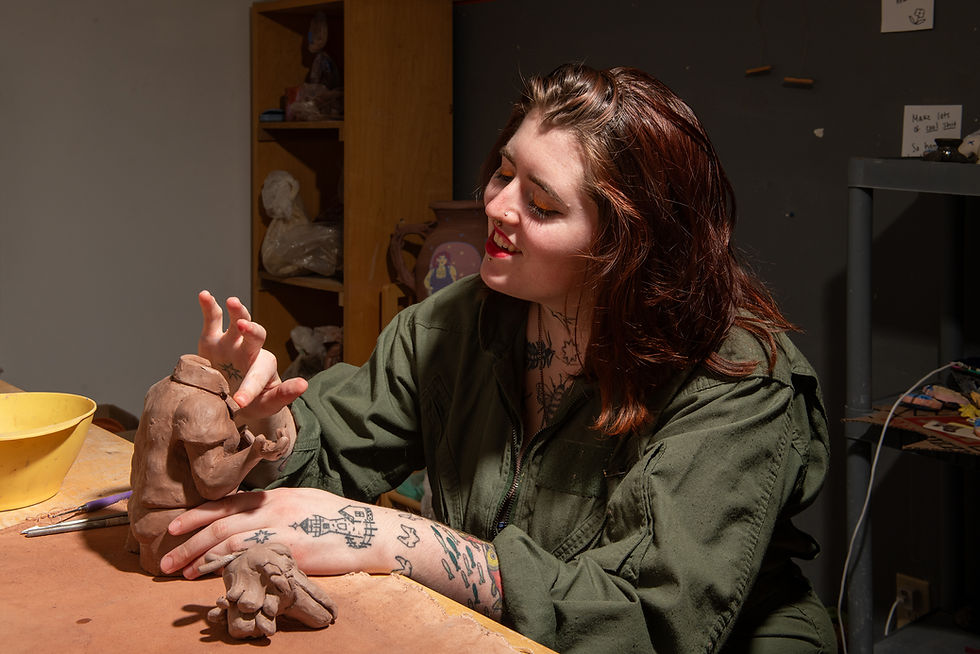
Gillman’s introduction to clay was during her first semester of college. She had only recently begun experimenting with multimedia art, adding sculptural three-dimensional aspects to her paintings. Clay was a natural fit for Gillman’s intuitive creative approach. She points to one of two vessels in progress on the table in front of her, “Even now, erasing part of the face to get the nose right, I see where the nose is going to go. I’m imprinting the visual and then following that as a sketch.” Gillman does minimal sketching of the imagery she wants to use at the start of a creative spark because, for her, the idea needs to be born in the third dimension. Planning feels too restrictive and not all of her illustrations translate to the final design when it changes dimension. If she gets attached to how something is at one angle, Gillman loses sight of the rest and the full 360, and the piece ends up worse for it. She has more success when the imagery comes after form, rather than turning an illustration into clay.

Her ideas start with a shape, like a decorated framed pot with a more traditional form or the shape of a building. Then the idea swirls around in her mind until color, theme, and approach begin to surface from her subconscious. Her forms are coil-built by hand and on the wheel, and when she gets to the base of the form she knows where the vessel is going to go and matches the silhouette to her mind. “There’s always the problem solving and idea creation that happens as you’re making but, generally, I go into making with a complete visual [in mind].” The colors and composition emerge intuitively through her hands and develop improvisationally in response to form.
Gillman explains that coil building and coil throwing are imperfect processes in which the coils create their own angles and have the potential to become an unpleasant shape or a form that won’t hold itself upright. It’s not possible to finish a pot in one sitting because when the clay is wet it will split and fall apart or become squat. This has made Gillman good at working in multiples. Working on more than one piece at a time causes the work to speak to each other through the qualities of her illustrations, line, and color. “It’s a huge responsibility making something that could exist forever, in some way, once you fire it. So, I try to sit with an idea for a while before I even attempt to start putting it into ceramic.”
Gillman’s work has a strong sense of personal style. All of her pots have some form of human representation, and most are centered around people. Gillman has largely focused on the experiences of women growing up in a misogynistic culture. Sometimes these depictions of female relationships hit close to home, as growing up almost exclusively around women has shaped her most valuable relationships. “Towards the end of my thesis I felt a huge weight of responsibility to represent and capture a broader lived experience–that’s not possible for one person to do.” One of the pieces in Gillman’s thesis was a kylix, a large Greek ceramic dish with a long stem made to hold an entire bottle of wine. In a historical context, drinking from one of these vessels without spilling was a challenge to show poise and refinement. Gillman chose the shape for the amount of interior and exterior space on which to illustrate. She called the piece “Girl Culture” and decorated it with depictions of ‘shot girls’ and ‘call girls’ to illuminate how girls are encouraged to monetize their sexuality and highlight the predation that so often accompanies this patriarchal system of value. For her it also represents the feeling of being pitted against other women.


After graduation, Gillman felt like she needed to tackle another challenge and looked inward. “I have never been able to make, in clay, anything about myself. These two pots are the first time I have had representational images of myself on a piece of ceramic.” She says it feels strange, committing her experience to clay forever. Any time she’s tried to depict herself, previously, Gillman’s figures always became some other woman–a female avatar–that was a stand-in for her. She felt pressured to be true and right; and the pressure of not being able to talk about yourself without talking about other people, such as her mother and grandmother, always created an overwhelming sense of responsibility.
The two pots in front of her depict Gillman and her best friend since childhood. The pots are a snapshot of growing up on Mount Desert Island and reconnecting as adults. “I never realized before I left that I was lucky to live in the place where I was: close to the beach, mountains, ponds, lakes, and rivers–all of the natural wonders Maine has to offer in one space.” The series focuses on the relationships she cultivated in that time and space and finding comfort and community in others experiencing a similar feeling of being an outsider. She’s looking back in time and cultivating an appreciation for a place she can’t be anymore.
These experiences are now compartmentalized into a series of six vessels that have an autobiographical feel. Those early female friendships and the land she grew up in were a lifeline for Gillman. “I came into the residency thinking I would tell a story about the place I grew up and about this person who grew up with me. I did that in an obscure way because I had to break up these pieces to tell a story about myself.” The series was created with intention as well as allowing room for Gillman’s subconscious to speak. “In this series I was hoping to make something more focused, existing in actual space and drawing from real imagery.” She ended up branching out because she was homesick, which is what initially drew her to working with memories from childhood. “Now that I’m this far into it, I’m starting to realize where this is actually coming from.” Making the vessels has been a process of self-discovery.
Gillman plans to continue working with clay as a part of her practice post-residency, and she is looking forward to getting more ambitious with her multimedia work. She plans to experiment with macrame and papier mache to make vessels on an even larger scale that can be reasonably made and moved. She says she’s feeling inspired to be vainer in her making, making the work she’s excited to see come into the world.
Contact Seraphina Helen Gillman through Instagram, @gillmanceramics.


Comments